Choosing a reliable Rail Welding Machine manufacturer requires more than comparing prices or browsing factory websites. Rail welding affects track strength, alignment, maintenance schedules, and passenger safety. The right supplier should demonstrate engineering competence, stable production, practical field experience, and responsive technical support.
This guide examines ten Chinese manufacturers that serve railway contractors, maintenance teams, and infrastructure buyers. Their capabilities may include flash-butt welding systems, mobile rail welding units, hydraulic equipment, control systems, and customized solutions. We consider welding performance, equipment durability, automation, operator training, spare parts, delivery experience, and after-sales service. Factory audits, product testing, certifications, and customer references also deserve careful attention.
Details matter.
A dependable supplier should explain welding parameters clearly, not hide behind broad marketing language. Buyers should ask how each machine performs on different rail profiles, in outdoor conditions, and during long maintenance shifts. Power requirements, transport dimensions, cooling systems, and repair access can strongly influence real operating costs. Some manufacturers may appear impressive online but provide limited evidence from active projects. That is worth questioning. Rankings can change as products, certifications, and service networks develop. This article is therefore a practical starting point, not a substitute for technical verification. By comparing documented strengths and possible limitations, readers can narrow their choices and contact suitable manufacturers with better questions.
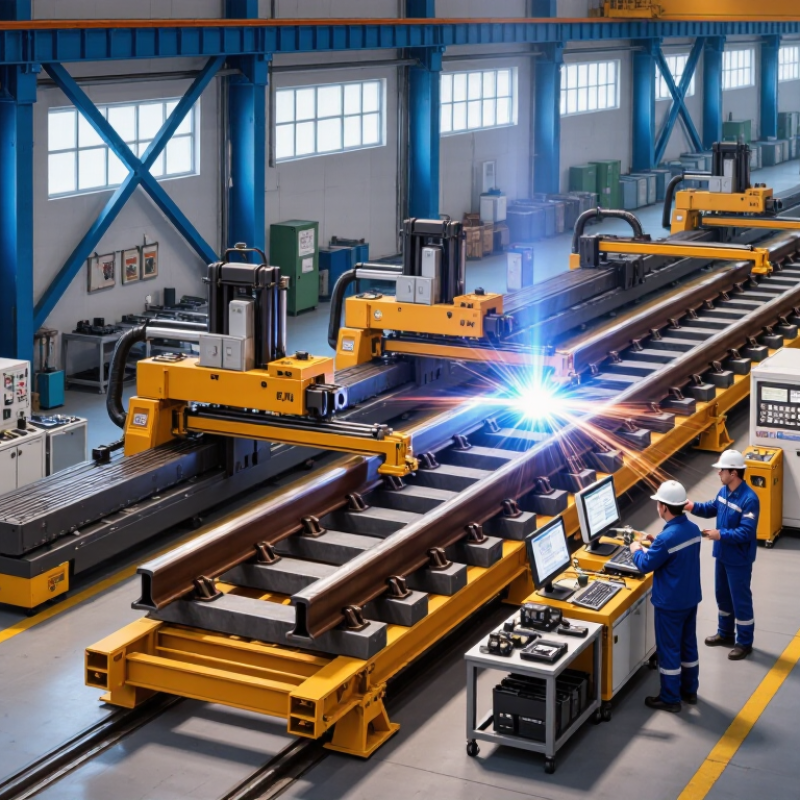
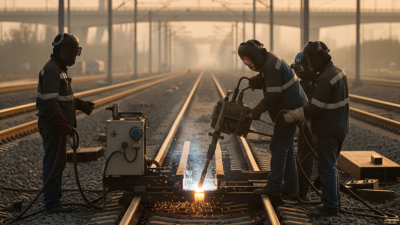
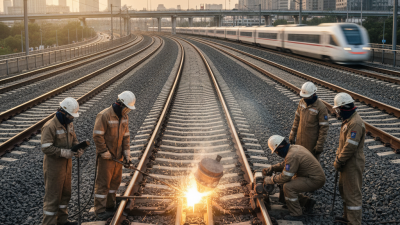
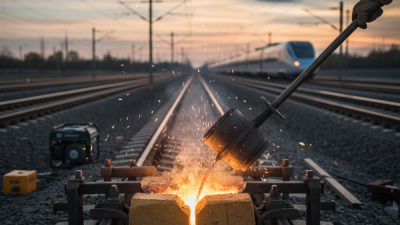
A rail welding machine joins two rail ends into one continuous track section. Most production systems use flash-butt welding. Hydraulic clamps hold the rails, while an electrical current heats their end faces. Controlled pressure then forces the softened steel together. Excess metal forms a flash and is removed by trimming tools.
The process looks simple, but alignment decides the result. Sensors check rail height, lateral position, temperature, current, and upsetting force. Operators also inspect the weld visually and use ultrasonic testing to detect internal flaws. Field machines may work beside the track, while stationary systems offer tighter control in a workshop. According to the International Energy Agency’s Tracking Transport 2023 report, rail carries about 8% of global passenger travel and 7% of freight movement, while using roughly 2% of transport energy. That efficiency depends on reliable track joints.
Professional buyers should compare welding capacity, clamp accuracy, generator stability, data logging, and maintenance access. EN 14587 and railway engineering manuals emphasize procedure control, material compatibility, and weld testing. A higher-rated machine is not automatically better. Poor rail cleaning or rushed calibration can still create a weak joint. That point is easy to underestimate. Real operating conditions, including rain, vibration, and limited working space, should shape the specification. Reports from the International Union of Railways also show continuing investment in network modernization, increasing demand for repeatable welding quality. Yet every machine needs trained operators and documented inspection records. Technology reduces risk, but it does not replace judgment.
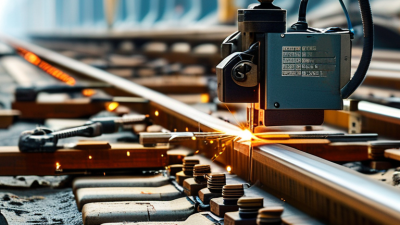
When choosing a rail welding machine manufacturer, start with proven field experience. Ask how many rail projects the manufacturer has supported, and in which climates. Welding performance should remain stable in dust, rain, vibration, and temperature changes. Request sample weld records, not only polished factory videos. Real evidence matters more.
Technical capability deserves close inspection. Check whether the machine controls pressure, current, alignment, and cooling accurately. Ask for measurable tolerances and testing methods. Reliable manufacturers provide calibration reports, operating manuals, and traceable component records. They should also explain how weld quality is inspected after production. Ultrasonic testing, visual checks, and dimensional measurements can reveal different problems. One test is never enough.
Service capability often separates a useful supplier from an expensive mistake. Confirm spare-part availability, remote support, response times, and technician training. Visit a working site if possible. Watch the setup process, cable handling, safety controls, and operator workflow. A machine may look excellent in a showroom but perform poorly beside an active track. Be careful with impressive promises. Some specifications sound precise but lack practical context. I would also ask for references from comparable rail conditions. No evaluation is perfect. Leave room for field feedback, because maintenance habits and operator skill can change results.
This suggested procurement model assigns a total weight of 100% to the most important purchasing criteria for rail welding machines. Compliance with railway welding standards, weld quality, productivity, compatibility with different rail profiles, and process control receive the highest weights because they directly affect safety, reliability, and lifecycle performance. Buyers can apply the same scoring framework consistently when comparing shortlisted manufacturers.
China’s top 10 rail welding machine manufacturers are gaining attention as railway construction expands. China State Railway Group reported more than 159,000 kilometers of railway in operation by the end of 2024. High-speed lines exceeded 48,000 kilometers. This scale creates steady demand for mobile flash-butt welders, rail end-face grinders, and automated inspection tools.
The leading manufacturers usually compete on welding stability, field mobility, and after-sales response. A reliable machine should control current, pressure, upset distance, and cooling time precisely. These factors directly affect joint strength and grinding accuracy. Buyers should also check compliance with EN 14587, EN 14730, and applicable Chinese railway specifications. Laboratory certificates matter, but site records matter more. Dust, rain, vibration, and limited track access expose weak designs quickly.
Public industry reports often forecast continued growth in railway maintenance equipment through 2030, supported by network expansion and renewal programs. However, a ranking is never absolute. Production capacity may look impressive, while spare-part delivery remains slow. I would request weld logs, calibration records, operator training details, and references from comparable projects. Ten manufacturers may appear similar on paper. They are not always equal beside a live railway.
China Top 10 Rail Welding Machine Manufacturers to Buy From?
Choosing among China’s leading rail welding machine manufacturers requires more than comparing prices. Product design should match the rail profile, welding method, and site conditions. Flash-butt systems need stable current control, accurate hydraulic pressure, and reliable electrode alignment. Portable units should include strong lifting points, protected cables, and clear control panels. Data logging is valuable because it records welding temperature, pressure, and cycle time for later inspection.
Certifications deserve careful checking. ISO 9001 can indicate a controlled quality system, but it does not guarantee every machine performs well. Buyers should request valid test reports, electrical safety documents, calibration records, and certificates accepted in the destination market. Check serial numbers and certificate scope. A polished document folder proves little by itself. Factory audits, sample welds, and video demonstrations offer stronger evidence. I would also inspect spare-part quality, because small hydraulic seals can stop a project.
After-sales support often separates a dependable supplier from an inconvenient one. Ask about installation training, remote troubleshooting, response times, and local service partners. Confirm whether software updates and replacement components remain available after purchase. A useful supplier should provide welding procedures, maintenance schedules, and operator training in clear English. Some promises sound excellent before payment, then become vague. Put every service commitment into the contract. Even careful buyers can overlook transportation damage, so request protective packaging photos and a commissioning checklist before shipment.
| Rank | Supplier Reference | Typical Machine Configuration | Applicable Rail Profiles | Welding Process | Automation and Control | Typical Electrical Supply | Certification and Compliance Evidence | After-Sales Support | Recommended Buyer Check |
|---|---|---|---|---|---|---|---|---|---|
| 1 | Supplier Reference A | Fixed flash-butt welding line with automatic rail clamping and upsetting | Common standard and heavy rail sections; model-dependent | Flash-butt welding | PLC control, welding-current monitoring, automatic weld-cycle recording | Three-phase industrial power; voltage and frequency configured by project | Request ISO 9001 certificate, electrical conformity documents, risk assessment, and model-specific test records | Remote commissioning, spare-parts list, operator training, and telephone or video support | Confirm production capacity, weld acceptance criteria, and reference installations |
| 2 | Supplier Reference B | Mobile flash-butt welding machine for trackside operation | Standard-gauge rail sections; compatibility depends on rail dimensions | Flash-butt welding with hydraulic upsetting | Semi-automatic cycle, hydraulic pressure display, stored welding parameters | Generator-powered or site-connected three-phase supply | Verify ISO 9001, CE-related technical documentation where applicable, and electrical safety test results | On-site installation, commissioning checklist, maintenance training, and consumables guidance | Check transport dimensions, lifting points, generator requirements, and field welding records |
| 3 | Supplier Reference C | High-output stationary welding system for rail-plant production | Standard, heavy-haul, and turnout-related rail sections subject to tooling | Flash-butt welding | Industrial PLC, recipe management, data logging, and fault diagnostics | Dedicated three-phase supply with project-specific transformer requirements | Request ISO 9001, factory acceptance test procedure, calibration records, and applicable rail-quality documentation | Planned maintenance schedule, replacement-part support, software backup, and technical documentation | Evaluate cycle time, electrode life, alignment accuracy, and availability of local service engineers |
| 4 | Supplier Reference D | Portable rail welding unit with integrated hydraulic power pack | Light and standard rail profiles within the machine's clamping range | Flash-butt welding | Operator-assisted controls, digital pressure display, manual alignment adjustment | Portable generator or external three-phase connection | Confirm ISO 9001, electrical protection tests, hydraulic-pressure test records, and user manual language | Basic training, remote troubleshooting, consumable recommendations, and spare hydraulic components | Verify total machine weight, setup time, rail alignment tolerance, and field safety procedures |
| 5 | Supplier Reference E | Rail flash-butt welder designed for depot and maintenance applications | Standard rail sections; special profiles require dedicated jaws and tooling | Flash-butt welding with controlled upsetting | Digital interface, parameter presets, emergency-stop circuit, and cycle alarms | Three-phase supply; exact current demand must be confirmed from the technical datasheet | Request ISO 9001, machine risk assessment, electrical schematics, and factory inspection report | Installation supervision, user training, preventive-maintenance guidance, and remote diagnostics | Ask for sample weld results, production references, and a written response-time commitment |
| 6 | Supplier Reference F | Modular welding machine with replaceable rail clamps and tooling | Multiple rail sizes when matching clamping fixtures are supplied | Flash-butt welding | PLC-based operation, adjustable welding recipes, pressure and displacement monitoring | Industrial three-phase supply; transformer and cooling requirements vary by model | Verify ISO 9001, component conformity files, calibration certificates, and applicable local standards | Tooling replacement, software assistance, spare-parts quotation, and remote service support | Confirm changeover time, spare-clamp availability, and compatibility with the buyer's rail standards |
| 7 | Supplier Reference G | Containerized or skid-mounted rail welding station for overseas projects | Project-specific rail profiles and gauges | Flash-butt welding | PLC control, remote monitoring option, multilingual HMI, and batch records | Configured for destination-country voltage and frequency after technical review | Request ISO 9001, export packing documentation, electrical conformity records, and FAT/SAT plans | International installation, online training, documentation package, and remote troubleshooting | Review container dimensions, customs documents, warranty coverage, and local-language manuals |
| 8 | Supplier Reference H | Cost-efficient semi-automatic rail welding machine for general maintenance | Common rail profiles within stated jaw and electrode dimensions | Flash-butt welding | Manual setup with digital readouts and automatic welding sequence | Three-phase industrial supply or approved generator configuration | Check ISO 9001, electrical safety documentation, hydraulic test reports, and inspection records | Remote technical support, standard spare parts, operating instructions, and commissioning assistance | Compare total cost of ownership, electrode consumption, warranty terms, and service response time |
| 9 | Supplier Reference I | Heavy-duty rail welding system with enhanced cooling and hydraulic capacity | Heavy rail and high-load applications subject to verified machine capacity | Flash-butt welding | Automatic cycle control, temperature or cooling monitoring, alarm history, and data export | High-capacity three-phase supply with dedicated cooling and hydraulic systems | Request ISO 9001, pressure-vessel or hydraulic safety evidence where applicable, and FAT results | Planned service, spare hydraulic and electrical assemblies, technician training, and troubleshooting support | Verify continuous-duty rating, cooling performance, weld consistency, and maintenance intervals |
| 10 | Supplier Reference J | Customized rail welding solution integrated with inspection and finishing equipment | Rail profiles, gauges, and production requirements defined in the project specification | Flash-butt welding with optional post-weld finishing | Integrated PLC/MES interface, traceability records, automatic alarms, and quality-data export | Engineering review required for voltage, frequency, current, cooling, and compressed-air needs | Request ISO 9001, conformity declaration where applicable, software documentation, FAT/SAT records, and calibration evidence | Full project commissioning, operator training, preventive maintenance, software backup, and long-term parts support | Assess integration capability, data ownership, cybersecurity controls, acceptance criteria, and lifecycle support |
Comparison basis: The supplier references are anonymized procurement profiles. Actual rail compatibility, electrical ratings, certifications, welding capacity, warranty terms, and service commitments must be verified against the specific model, certificate number, contract, and factory acceptance test documentation.
Choosing a Chinese rail welding machine supplier requires more than comparing prices. Start with the welding method, rail profile, power supply, and expected site conditions. A machine for high-speed railway maintenance may need different control accuracy than one used in a depot.
Ask the supplier for recent project records, factory inspection access, and complete technical documentation. Check welding force, clamping stability, temperature control, data recording, and emergency shutdown functions. Request sample welds from rails matching your specifications. Review test results with an independent railway engineer when possible. Small gaps in documentation can become expensive problems.
Supplier reliability matters after delivery. Confirm spare-part availability, technician response time, operator training, and remote troubleshooting procedures. Clarify warranty coverage in writing. Visit the production line if practical. Look for calibrated testing equipment, traceable components, and workers who can explain quality checks clearly. A polished showroom proves little.
Do not accept vague promises. Ask for a factory acceptance test using your rail dimensions and welding cycle. Include transport protection, installation support, and software updates in the contract. I have seen buyers focus heavily on the purchase price and overlook maintenance access. That choice often creates delays. Even experienced teams can miss this detail. Compare lifecycle cost, not only the quotation.